
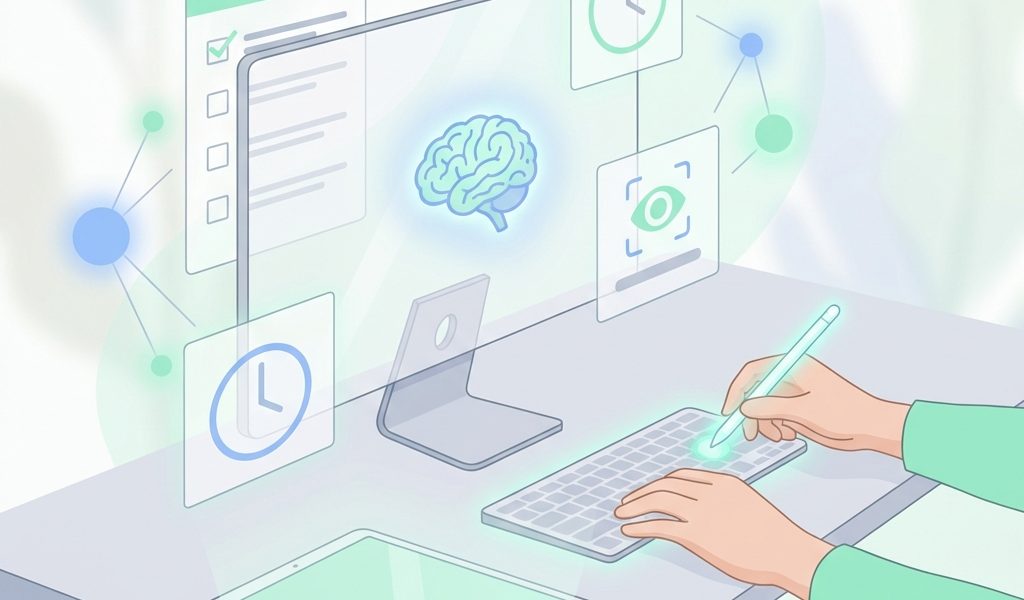
The Productivity Revolution is Already Here
For decades, productivity advice boiled down to the same handful of tips: make a to-do list, batch similar tasks, eliminate distractions, and wake up earlier. These strategies still work, but they are incremental improvements to a fundamentally manual process. Artificial intelligence has introduced an entirely new category of productivity gains, not by helping you work harder or faster, but by eliminating entire categories of work that you should not be doing in the first place. AI does not replace your creativity, judgment, or strategic thinking. It replaces the tedious, repetitive, time-consuming tasks that drain your energy and steal hours from the work that actually matters.
AI for Writing and Communication
The average knowledge worker spends nearly 30 percent of their workday on email and written communication. AI writing assistants like ChatGPT, Claude, and Jasper can dramatically reduce this time:
- Email drafting: Instead of staring at a blank compose window for five minutes crafting a polite response to a client, describe the gist of your reply in one sentence and let AI generate a professional, well-structured email in seconds. Review, adjust the tone if needed, and send.
- Meeting summaries: Tools like Otter.ai and Fireflies.ai automatically transcribe meetings, extract action items, and generate shareable summaries. This eliminates the need for dedicated note-taking during calls and ensures nothing falls through the cracks.
- Content creation: AI can generate first drafts of blog posts, social media captions, product descriptions, and marketing copy. These drafts are not publishable as-is, but they provide a solid foundation that is far faster to edit than to write from scratch.
- Translation: Tools like DeepL produce near-human-quality translations in over 30 languages, enabling communication with international clients and audiences without hiring professional translators for routine correspondence.
AI for Research and Information Processing
Gathering, organizing, and synthesizing information is one of the most time-consuming aspects of knowledge work. AI transforms this process:
- Document analysis: Upload a 50-page report to an AI tool and ask it to summarize the key findings, identify risks, or extract specific data points. What would take you an hour of reading takes the AI 30 seconds.
- Market research: AI can analyze competitor websites, customer reviews, social media sentiment, and industry reports to produce comprehensive market overviews in minutes rather than days.
- Data extraction: Tools like ChatGPT with Code Interpreter can process spreadsheets, clean data, identify patterns, and generate visualizations from raw datasets without requiring programming knowledge.
AI for Task and Project Management
AI-powered project management goes beyond simple to-do lists. Modern tools can predict project timelines based on historical data, automatically prioritize tasks based on deadlines and dependencies, suggest optimal scheduling based on your energy patterns and meeting calendar, and identify bottlenecks before they cause delays. Tools like Motion and Reclaim.ai use AI to automatically schedule your tasks around your meetings, protecting deep work time and ensuring your most important work gets done first. Instead of spending 15 minutes each morning planning your day, the AI does it for you based on your priorities and constraints.
AI for Creative Work
Contrary to the fear that AI will replace creative professionals, the most productive creators are using AI as a creative partner:
- Brainstorming: When you are stuck on an idea, AI can generate dozens of creative angles, headlines, or concepts in seconds. You provide the direction; AI provides the volume of options.
- Design: Tools like Midjourney and DALL-E generate professional-quality images, mockups, and visual concepts from text descriptions. Designers use these to rapidly prototype ideas before investing time in polished execution.
- Code generation: GitHub Copilot and similar tools can write boilerplate code, suggest function implementations, and even debug errors. Developers report productivity increases of 30 to 50 percent when using AI coding assistants.
- Music and audio: AI tools can generate background music, remove background noise from recordings, and even clone your voice for consistent audio content production.
Building an AI-Powered Workflow
The most productive approach to AI is not using every tool available but identifying the specific bottlenecks in your personal workflow and applying AI precisely where it creates the most value. Follow this process:
- Audit your time: Track how you spend your working hours for one week. Identify the tasks that consume the most time relative to their value.
- Identify automation candidates: Look for tasks that are repetitive, rule-based, or involve processing large amounts of information. These are ideal candidates for AI assistance.
- Select the right tools: Choose one or two AI tools that address your biggest time sinks. Master them before adding more. Tool overload is itself a productivity killer.
- Create templates and prompts: Develop reusable prompts for recurring tasks. A well-crafted prompt for your weekly client update email, for example, saves time every week.
- Review and refine: AI output always requires human review. Build a habit of checking AI-generated work for accuracy, tone, and appropriateness before using it.
The Human Skills That Matter More Than Ever
As AI handles more routine tasks, certain human skills become dramatically more valuable: critical thinking (evaluating whether AI output is accurate and appropriate), creativity (generating original ideas that AI can help execute), emotional intelligence (understanding and responding to human needs in ways AI cannot), strategic judgment (making decisions about direction, priorities, and trade-offs), and communication (articulating complex ideas clearly and persuasively). The professionals who thrive in the AI era will not be those who resist the technology but those who leverage it to amplify their uniquely human capabilities.
Conclusion
AI is not coming for your job. It is coming for the parts of your job that you probably do not enjoy anyway: the repetitive emails, the tedious data entry, the hours spent searching for information. By thoughtfully integrating AI tools into your workflow, you can reclaim hours each week for the creative, strategic, and interpersonal work that is both more valuable and more fulfilling. Start with one bottleneck, apply one tool, and measure the time you save. The results will speak for themselves.